Many within the ‘Save the Earth from Climate Change’ group are promoting doubling the land mass that is ‘Protected’. Protected areas are considered to be areas like national parks, Yellowstone National Park being one of them. Sadly, studies of the Yellowstone show land degradation continuing even though considerable study and resources have been used to reverse this trend. The Jornada Experiment station in New Mexico is another glaring example of what happens to land within a ‘brittle’ environment that are ‘protected’. (Protected area from grazing livestock was created some 90 years ago, to preserve an area of grassland, it is now a barren desert.)
Sound grazing management is perhaps the most valuable environmental solution or tool to a continually changing climate and the resources available to PROTECT the environment.
As the pictures below depict rangeland ‘protected’ from environmental destruction utilizing a controlled graze-rest program can be extremely valuable in preserving The Lords creation and the resulting environmental sound processes. (Some call it Natures; I consider it one in the same)
Big Blue or Sand Blue, Indian Grass, Side Oats, Little Blue: The mineral and water cycles at their best.
A few yards away Switch Grass taking hold in overflow area.
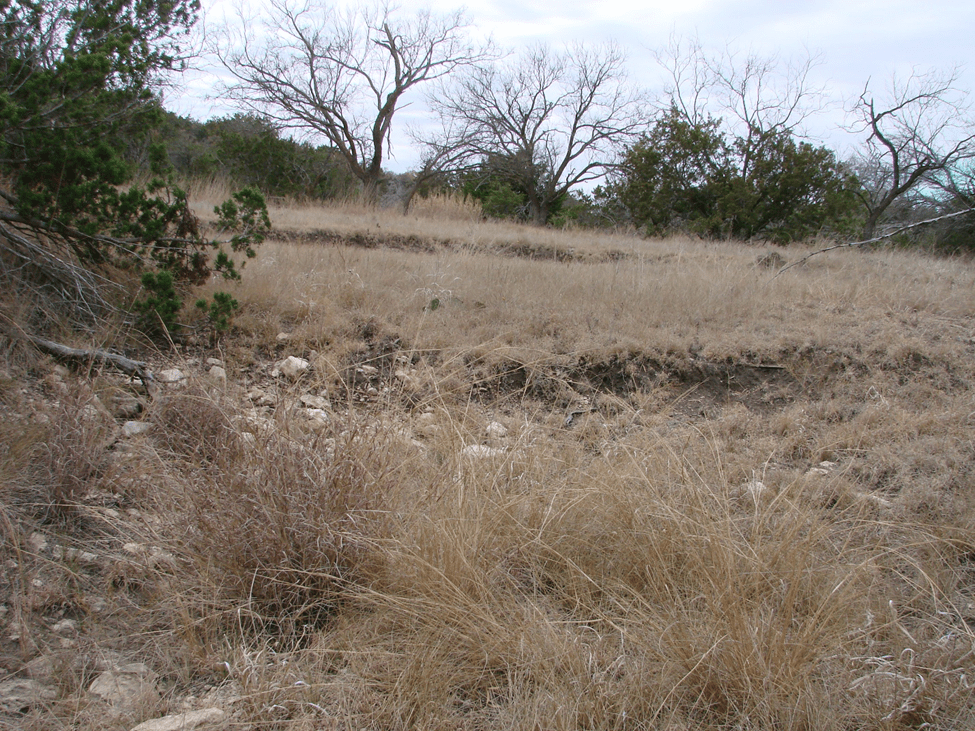
Former erosive area recovering nicely. Note the Switch Grass in the background.
An excellent example of recovery of a formerly erosive creek, as at one time it was difficult to cross a horse at this location. As previously noted, creeks and riparian areas are the first to recover when a graze-rest grazing plan is put in place. While this can’t be considered a riparian area, as there is no water present, historical information indicates that early settlers to the area noted that this was within the area of the last ‘permanent’ water resources as one goes west along Lacy Creek. It is doubted that this water will ever be present on a continuing basis in the future, but with lots of TLC up stream (Grazing Management) it just might happen.
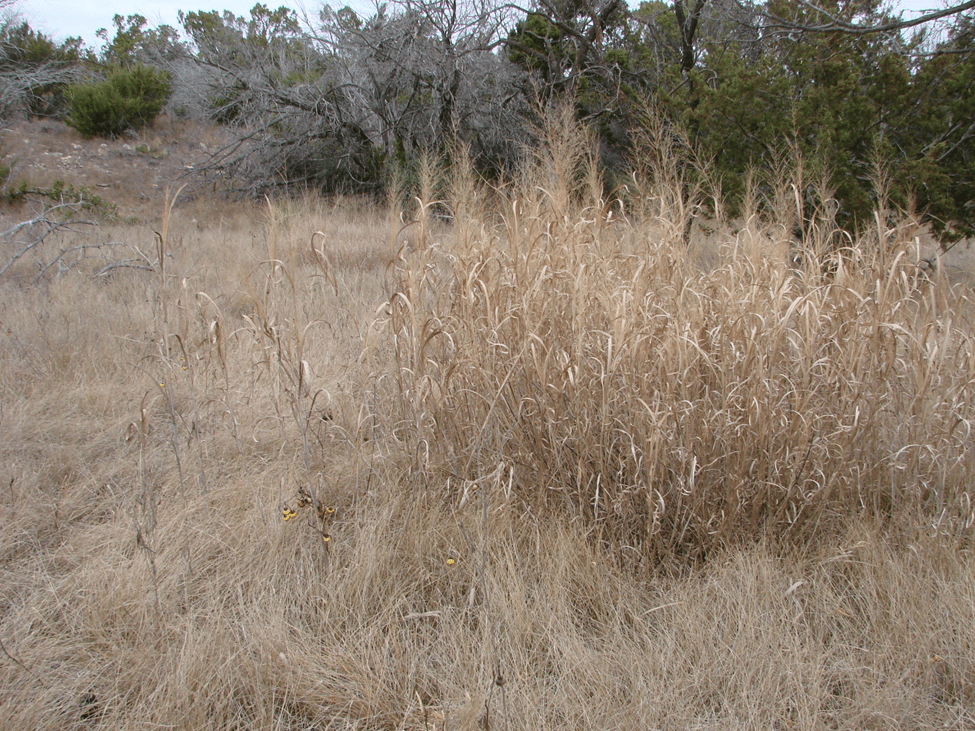
This photo was taken during the ‘warm-growing season’. The excellent growing conditions of the summer of 2021 have succumbed to excessively dry conditions this fall. Am grateful the sound grazing management has provided the grazing forage to see us through the cold and dry times. Hopefully the rains will come soon as cool season perennials are common now that the rangeland has begun to recover from past grazing mistakes. It is estimated that 25% of the grasses in this photo are cool season plants. (Canada Wildrye, Texas Bluegrass, Western Wheat and Texas Winter grass)
Formerly Erosive Creek Bank, Repaired with Proper Grazing Management
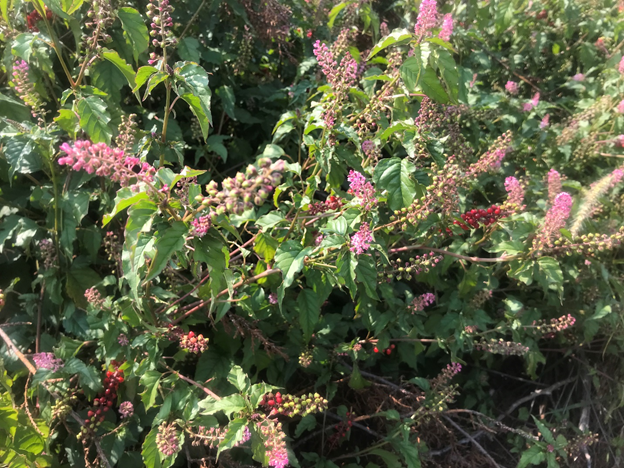
Found this specimen growing in the pasture this past week. It is a first for me, as I do not remember seeing it before. Come to find out it is a popular ground cover plant for gardeners and when I showed Ginger the photo her immediate comment was ‘You can bring that one home and plant it.’ (We have an ongoing battle with the plants I wish so plant around the house and those that she wants. Beauty is in the eye of the beholder.) May take her up on this one.
Pigeon Berry is one of those perennial natives that is highly preferred by livestock and wildlife alike and perhaps another one of those positive rangeland health indicators. The beauty and resilience of well cared for, healthy rangelands is an awesome sight to see. Take care that the land you are associated with is protected and the tinder loving care of it is a priority. Do not let is get away.
Watching cattle graze and asking why they eat what they do, can be considered a waste of valuable time for some, but not when the manger is seeking to accomplish the goal of rangeland improvement and understanding why certain things are happening to the rangeland resource, the study can be quite interesting.
At first glance, what the cow, sheep or goat eats appears to be somewhat indiscriminate, as she has her head down and does not appear to be focusing on certain plants. However, when she bites into a plant that seems to have a better flavor-more succulent-easier to chew- more nutritious??-contain a particular nutrient that she is craving??, she will concentrate on that plant for a few moments then move to the next area. (One thing of note: The higher the density of grazing animals in a given area the less discriminant they are. Competition for grazing space can be an interesting aspect of how the grassland manager manipulates his livestock.)
What plants do they prefer? Why are some grazed shorter than others at first bite? (Switchgrass, Indiangrass, Kline grass, Sideoats and many others will have the top 1/3 to ½ of the plant grazed the first round. Other plants will be grazed to a noticeably short level up to 90% the first grazing even in good growing conditions, but then totally avoided during other times. (Old World Bluestems, Rough Tridens and Sand Drop Seed)
‘Take half leave half’ I wonder. Each plant appears to have developed growth characteristics that promote survival and adaptation to the grazing animal’s preferences. Grassland management is not an exact science. The many variables cause for numerous undeterminable equations.
THE BETTER IT GETS THE FASTER IT GETS BETTER.
Pictures depict Switchgrass prior to and after one day of grazing. It is a highly preferred grazing plant.
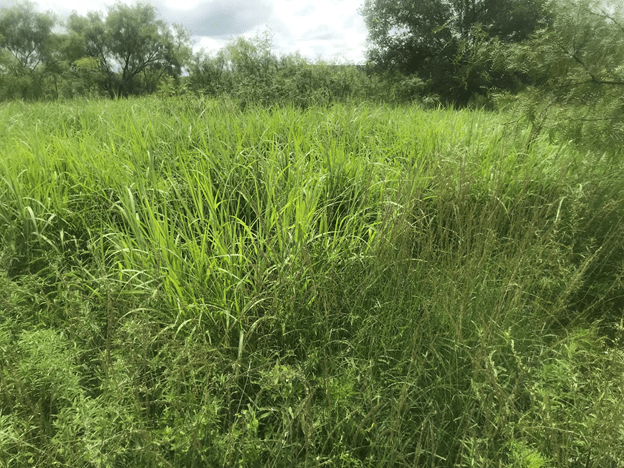
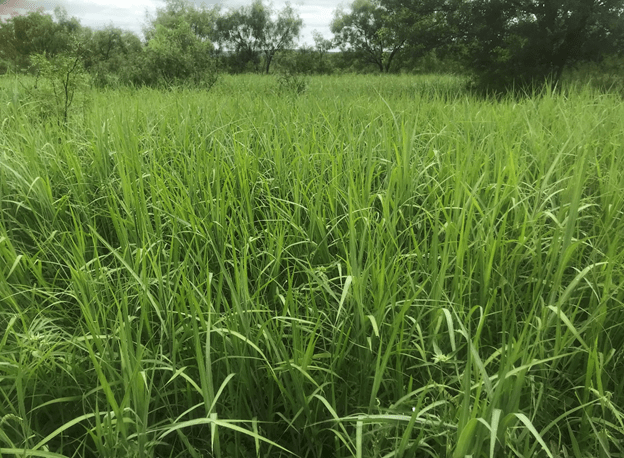
While many areas of West Texas are suffering through drought conditions, the excellent growing conditions some are experiencing this year are magnified on rangeland that has been under a properly applied graze-rest program. This photo, taken in western Sterling County, is one of the largest pure stands of native Switchgrass rangeland in memory. (Not planted or expensive land preparation utilized, only nature taking advantage of climatic and management conditions.) It is interesting that some Johnson Grass can be found in the immediate vicinity, but the Switchgrass is dominant and virtually a pure stand, bringing up questions of diversity in a native rangeland setting. Close observation shows some Sideoats scattered within the dense stand of Switch, resulting in expression of one of nature’s rules, DIVERSITY IS KING.)
The photo puts the imagination to flourishing about the wonderment of tales of long ago, about stirrup high grass and phenomenal stocking rates of the early cattlemen in the area. This Switchgrass savanna is in an overflow area and has stabilized the soil profile, making it very resistant to erosion. Think how heavy a rainfall event will have to be to create a flooding issue across this tributary of Lacy Creek and then it will run virtually clear water.
Will this newly created grassland sill be vibrant during the next ‘dry spell’? Certainly not as beautiful as the photo of today shows, but with careful planning and continued graze-rest that, dry spell will not be as significant of a drought as poorly grazed areas. (Perhaps will not be considered a drought at all.)
It will be interesting to watch the scattered Mesquite within the Switchgrass and see what its response to intense competition will be. Most likely those mesquites will remain small with continued healthy grazing management and PERHAPS few seedlings will survive or germinate.
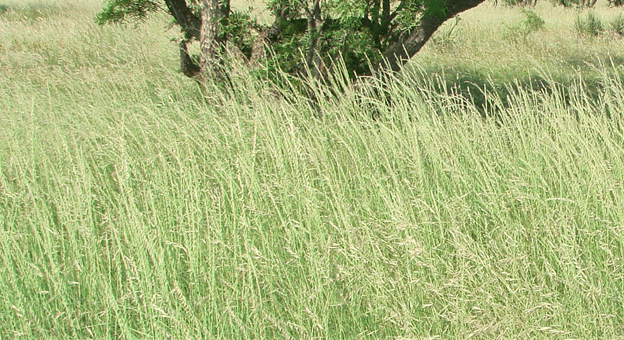
Established Texas Winter Grass can provide an excellent area for higher succession plants such as Sideoats Gramma to take root and move the rangeland ecosystem forward, improving the drought resistance of the landscape. The partial shading of the soil allows limited available moisture to not be lost to evaporation, and the resulting ground litter from decay and animal trampling (Even the hated spear seeds) provide extra humus and slows water movement reducing the loss of rainfall due to runoff. All resulting in effective use of available rainfall. This positive scenario can provide excellent conditions for seedling establishment of higher succession plants that provide deep rooted, highly palatable drought resistant forage. This phenomenon is seldom seen under continuously grazed rangelands, but with a controlled graze-rest program the possibility is strong.
Zoom in on the photo to examine the ‘spear grass’ hulls remaining from the dropped ‘spears’ and take note of the excellent stand of Sideoats growing within the Winter Grass. Dual season grazing at its best or at least at the current succession level. It can get much better with even higher succession plants that will establish and flourish with continued tender loving care.
Bush Sunflower rarely seen on rangeland in our area, with the exception of the lonely one growing within an existing ‘bush’ such as skunk brush or any other low growing bush that protected the highly palatable bush sunflower form being grazed to ‘death’. Although the leaves and stems feel very harsh being somewhat scratchy and not being a particularly showy or pretty ‘weed’, livestock and wildlife alike readily graze it. Being a perennial plant having 26% to 31% protein in the early spring, its robust root system makes it a drought tolerant plant that can be an unbelievably valuable resource for rangeland health and the ranchman’s pocketbook. (A very opportune time to have a high protein source of forage available coming out of winter months.) The assumption that the bush part of the name was derived from its tendency to be found growing within a bush, is supposedly incorrect, as given the opportunity to flourish within a good grazing program it is said to develop a bush like appearance. (Still waiting to observe this.) As time goes by, on rangeland protected by a good graze-rest program, the plant is becoming ever increasing in prevalence like the one pictured below, without the ‘bush’ being present. (Young mesquite in picture being excepted) Areas that are under a continuous grazing program seldom have bush sunflower present other than those growing in a bush as referred to above. When numerous bush sunflowers are present, it is an excellent indicator of improving rangeland health.
Had the honor of making a presentation at the 2021 Hemphill County Beef Conference. One of the best county organized symposiums I have seen, learned much more than I had to offer. Andy Holloway and his Ag Committee did an outstanding job. The first session of my talk is below. A short ad is seen prior to my presentation, which depicts the quality of the Hemphill County symposium, the paid supporters of the program were recognized often.
Microbiome: Now that is a complicated word for a country boy that is very dependent of and thankful for Word and Spell Check. With all its complexity and lack of understanding, I am going to predict that the study, and understanding of microbes (bacteria, fungi, viruses and other one celled organisms) and the role they play in virtually every living thing, will ultimately be one of the most important discussions and understanding of the world we live in that modern science has ever taken on. Simply put microbes are everywhere, some are considered to be bad, but most are beneficial and are being found to be key combaters of the bad ones. Overall scientists are finding microbes are important to our health along with the health of livestock and the rangeland resource. (Early on many believed that virtually all microbes were bad and needed to die, thus the rampant use of antibiotics, that paradigm is changing quickly.)
As we begin to recognize how important soil health is to our rangeland resource and how positive change can quickly occur. It is also being seen that microbe activity within that soil profile are not only the result of good grazing management practices but given the opportunity those microbes move the soil health forward, thus making the rangeland that much more productive. Microbes along with ‘critters’ like earth worms and dung beetles are what breaks down manure, old grass, leaves and wood into humus and are also responsible for the wonderful aroma that fresh tilled soil produces. (Try sticking your finger into a heavily grassed area and smelling the dirt, then scratch that finger into bare soil. The difference in smell is very noticeable.) The trick is to provide an environment for those ‘little fellers’ to flourish. Bare ground and poor soil moisture are not the environment they need. Through a good grazing management program, the soil profile is improved so moisture is retained and a food source (decaying plant material) is available to those microbes. Once that process is established the soil profile begins to improve at an exponential rate- if the grazing program remains active- revert to a poor grazing management regimen and the process will cease, taking the condition of the rangeland back to its original depleted state.
Neat thing is we don’t have to buy any microbes from a dealer, all that is required is apply the proper management and the little critters do it on their own. Trash farming or no till as it known to some, can result in amazing transition. One farmer I know, after initiating his ‘trash farming’, took his tilled soil from 0.3% humus to 3.0% in just three years. Rangeland soil health improvement is very notable within a few years of instigating an effective grazing management program.
Improving cattle health has numerous opportunities with the use of microbial research not only for the digestive system but even the respiratory system. The understanding of these relationships of environment-plant-animal and human health and their relation to the microbes around us has great potential. A good article suggesting these relationships can be found in Drovers Journal. https://www.drovers.com/article/bugs-airway Another source of information is: https://soilsmatter.wordpress.com/…/what-is-the-soil…/
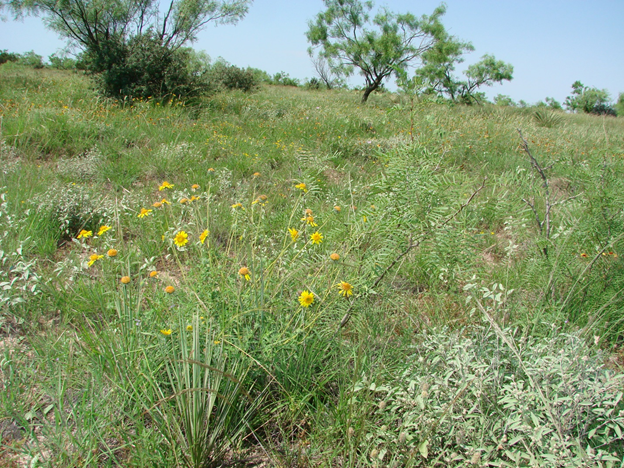
Engelmann or Cut Leaf Daisy in full bloom. The pasture pictured will not have livestock in it until May 15, plenty of time for the highly preferred grazing plant to secure its perennial root and reproduction systems, so that it can be available next year for increased grazing capacity. Yes, it will be grazed during a slightly different season the next grazing cycle.




 Rangelands and Ranching