A veteran producer recently asked me: Is the current drought worse than the one in the 1950’s? My quick response was that we hadn’t seen anything yet. As in the early ‘50s drought, the rain gauge at the Bobs Creek headquarters (My home) had an average rainfall of just under 6” per year for a four-year period and the drought lasted from 6 to 7 years depending on the area.
Then it occurred to me that the rangeland was in much better condition prior to the ‘50s drought than it is today. Remember the story of a long-time rancher telling me when I was in my 20’s (late 1970’s) that: “With each passing dry spell one can never run as many livestock as he could prior to that dry spell.” Loss of grazing capacity has dwindled from documented grazing of 100 plus animal units per section in 1880 to 15 -10 and even less animals per section today on the same rangeland. With that loss of grass density, root structure in the soil (sod if you will) loss of topsoil due to erosion, soil health decline and density of brush cover increase. The limited moisture that has fallen during this dry period has considerably less opportunity to produce new growth providing all of the benefits healthy growing plants provide. (5.49” for the year at his point in 2024 at my house)
So perhaps on rangelands that are not under an effective grazing management program this drought is possibly worse than the 1950’s event. Many to the north and east of my area have had a tremendous rainfall year and recovered well, but even in those areas I suspect it is noticeable which operations have practiced a good grazing management program prior to and during the dry conditions before the rains came.
Just a few miles to the west of me it is obvious that the desert is steadily encroaching to the east and without a dramatic change in grazing technique this trend will continue. The knowledge is out there, and the time is here to do something about it.
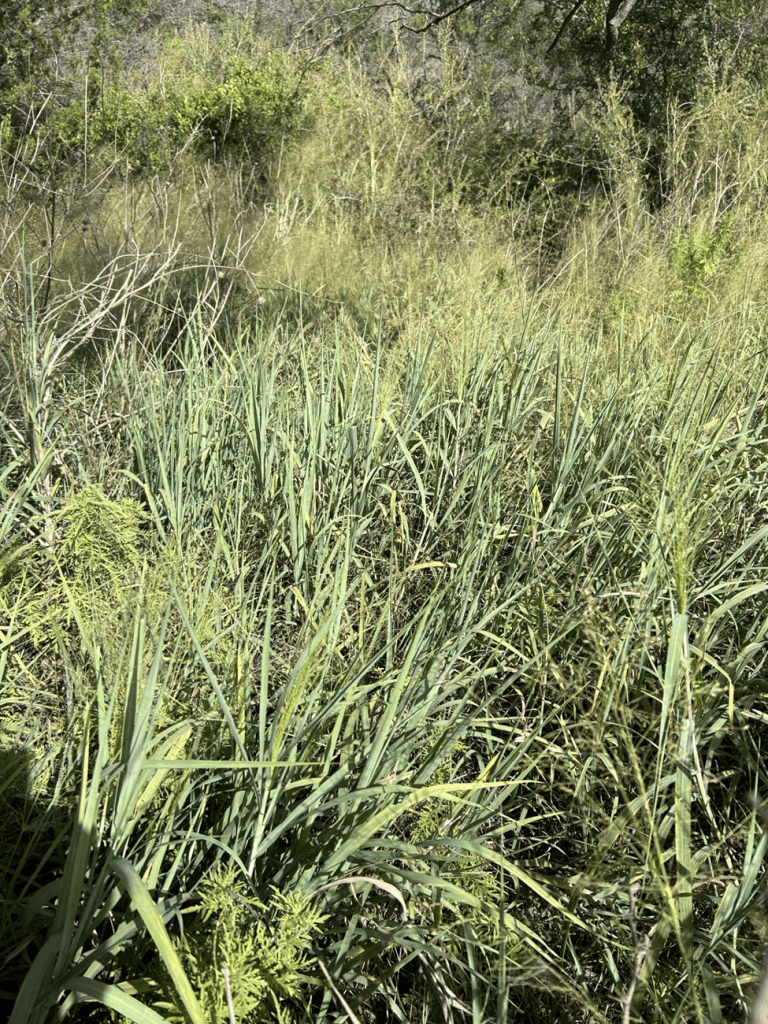
The photo below is of some native-unseeded Switch grass that has survived from many years of abuse (heavy brush and very forbidding-rough terrain has protected these surviving plants) and under the current Graze-Rest-Graze-Rest program is making a strong recovery even without a direct water source. (Most consider Switch grass to be dependent on a close source of water, springs-sub irrigated-intermittent standing water.) Think back to the beginning of the cattle industry in West Texas when Switch grass and other tall grasses were healthy and numerous, this ‘little’ dry spell would have a much different affect and would have little consequence to the long-range health of the plants with a healthy rangeland in place before the droughts beginning.
The Better it Gets the Faster it gets Better
 Rangelands and Ranching